Curtis.Castiglione@ROzebra.com

Understanding Brake Bias: Proportioning Valves and EBD
Have you ever hit the brakes on a rainy day and felt like the back end of your car wanted to overtake the front? Or perhaps you have noticed that even during a normal stop on dry pavement, your brake pedal starts that rhythmic pulsing—the anti-lock braking system (ABS) kicking in—much earlier than it used to.
It is a disconcerting feeling, almost as if the car is 'tripping over its own feet' or the rear wheels are trying to let go of the road. These aren't just the quirks of an aging vehicle; they are specific warning signs that your car's brake bias is out of sync.
The Balancing Act: Front vs. Rear
As a technician, when a customer describes that 'twitchy' feeling, my mind immediately goes to how the vehicle distributes stopping power. In a perfect world, your front and rear brakes work in harmony, but they don't do equal work.
When you decelerate, the vehicle's weight shifts forward. Because of this, your front brakes are designed to handle about 70 to 80 percent of the braking load. If the rear brakes receive too much hydraulic pressure, they will lock up because there isn't enough weight over the rear tires to maintain traction. To prevent this dangerous situation, engineers use two primary technologies: the mechanical proportioning valve and Electronic Brake Force Distribution (EBD).

The Mechanical Gatekeeper
In older vehicles and many pickup trucks, a mechanical proportioning valve acts as the gatekeeper of hydraulic pressure. Under light braking, the valve stays open to ensure all four wheels contribute to stopping. However, during heavy braking, it 'chokes' the pressure going to the rear wheels to prevent them from skidding.
On many trucks, this valve is load-sensitive. It is connected to the rear axle by a spring or linkage.
- The Logic: If you have a bed full of gravel, the suspension compresses, pulling the linkage and telling the valve to allow more pressure to the rear wheels because they now have the weight to handle it.
- The Problem: If you install a lowering kit or a lift kit without adjusting this linkage, the valve gets 'confused.' It may think you are carrying a massive load when the bed is empty, leading to premature rear-wheel lockup and making the vehicle incredibly unstable in a curve.
The Digital Brain: EBD
Modern cars have largely replaced the physical valve with EBD logic housed within the ABS control module. EBD is the high-speed, digital version of that mechanical valve. It uses wheel speed sensors to detect if the rear wheels are beginning to rotate slower than the front ones—a sign of an impending skid.

When EBD fails or behaves incorrectly, it is usually a data problem rather than a physical leak. Common culprits include:
- Faulty wheel speed sensors.
- Incorrect tire sizes (which confuses the speed calculations).
- A glitch in the ABS actuator.
This often manifests as premature ABS engagement, where the pedal vibrates even during moderate stops on perfectly good pavement.
Diagnosing the Pressure
If you bring your car to the shop with these symptoms, we don't just throw new pads and rotors at it. We perform a pressure differential test.
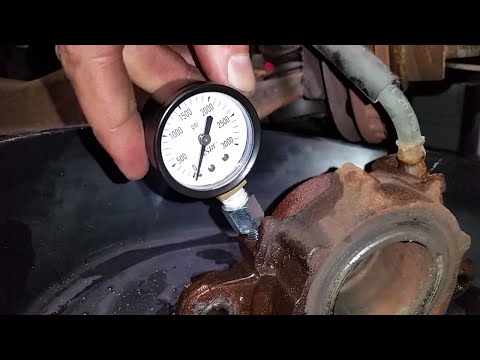
We hook up specialized hydraulic gauges to the master cylinder and the rear wheel circuits to see exactly when the pressure 'slope' changes. If we see 1,000 PSI at the front but the rear is also hitting 1,000 PSI during a hard stop, we know a mechanical valve has failed internally. For EBD-equipped systems, we use a diagnostic scan tool to monitor 'slip rates' in real-time to ensure the computer is commanding the solenoids to reduce rear pressure correctly.
Why You Should Not Wait
This is not an issue to ignore. If your rear brakes lock up before the front ones, you lose directional stability, which can lead to a dangerous spin-out during an emergency stop.
Watch for these red flags:
- The car 'dives' excessively at the front when braking.
- The rear end feels like it is swaying or 'fishtailing' during a stop.
- The ABS light flickers or the pedal pulses during normal, non-emergency stops.
If you notice these symptoms, tell your mechanic you are concerned about your brake bias or proportioning. Whether it is a bent mechanical linkage on an old truck or a sensor error in a new sedan, restoring that front-to-rear balance is the only way to ensure your car stops straight and true every time.
Written by Curtis Castiglione



No Comments Yet
Be the first to comment on this article.