Curtis.Castiglione@ROzebra.com

The Workhorse Chassis: A Hidden Heavy-Duty Donor Goldmine
By Curtis Castiglione
To the average person, a mid-2000s Class A motorhome or a tattered FedEx delivery van is nothing more than an eyesore or a traffic obstruction. To the seasoned engine swapper and heavy-duty fabricator, these vehicles represent one of the most cost-effective ways to acquire a drivetrain that can move mountains. Specifically, we are looking at the Workhorse Custom Chassis, a platform that carried on the legacy of the Chevrolet P-series vans and became a sanctuary for some of General Motors' most stout industrial components long after they vanished from the passenger truck market.
The Prize: The L18 Vortec 8100
The primary prize hidden beneath the fiberglass shell of a 2001 to 2009 Workhorse chassis is the L18 Vortec 8100. While the 454 cubic inch (7.4L) Big Block Chevy is a legend in the hot-rodding world, the 8.1L is its technologically superior, high-torque successor. Enthusiasts often overlook these because they were never offered in a half-ton pickup and were relatively rare in 2500HD and 3500 series trucks. However, in the world of motorhomes and delivery step vans, they were the standard.

What makes the L18 special compared to a standard 454 is not just the displacement. This is a tall-deck engine designed for a massive 4.37-inch stroke. It features a modern 18-bolt head pattern, symmetrical intake and exhaust ports that flow significantly better than vintage oval or rectangular port heads, and a coil-near-plug ignition system similar to the LS-family engines. Perhaps most importantly for the swapper, the 8.1L shares the classic Big Block Chevy bellhousing pattern, meaning it can bolt up to a variety of older manual and automatic transmissions.
The 'Heavy-Duty Cheat Code': The Allison 1000
If you find a Workhorse donor, you should not just pull the engine. These chassis were frequently equipped with the Allison 1000 five-speed or six-speed automatic transmission. In the consumer market, the Allison 1000 is almost exclusively associated with the Duramax diesel engine. Finding one mated to a gasoline Big Block in a scrap-bound motorhome is like finding a heavy-duty cheat code.

This transmission is rated for significantly higher gross vehicle weights than the 4L80E found in standard trucks. It is the gold standard for anyone building a dedicated towing rig or a heavy restomod. It provides the strength needed for massive torque loads while offering the overdrive gears necessary for modern highway speeds.
Never Scrap the 'Brain' of the Engine
This brings us to the critical point regarding the electronics. The engine controller (ECM) and the transmission controller (TCM) in these industrial applications are vital. The 8.1L uses a specific crank trigger and a unique firing order compared to the older Mark IV or Gen V big blocks.
The ECM in a Workhorse chassis is calibrated for a heavy-duty duty cycle, prioritizing torque management and cooling. If you are planning a swap, you must keep:
- The complete wiring harness (do not cut it)
- The ECM and TCM modules
- The throttle-by-wire pedal assembly
- All engine sensors (crank, cam, and O2)
- The ignition modules and fuel-control components

These modules communicate via a data bus to coordinate shifts; throwing them away means spending thousands on aftermarket controllers to do what the factory already perfected. Never scrap an engine's brain before you understand the engine. Once the engine is identified and your conversion strategy is established, you can decide what gets reused and what gets sold.
Beyond the Drivetrain: Axles and Brakes
The Workhorse and P30 chassis are gold mines for heavy-duty suspension and brake components. Many of these vehicles utilized Dana 80 or even heavier S110 rear axles, often equipped with limited-slip differentials and massive disc brakes.
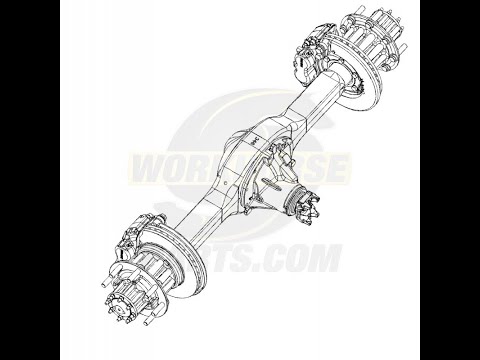
For a builder working on a 1970s era truck that originally came with drum brakes and a light-duty rear end, the axles from a delivery van can provide a modern, high-capacity foundation for a fraction of the cost of aftermarket crates. When evaluating one of these donors, you must distinguish between the standard GM P-chassis and the upgraded Workhorse W-series. The W20 and W22 chassis are particularly desirable because they featured wider tracks and larger brakes.
Practical Considerations for the Swap
Be aware of the accessory drive; industrial engines often use high-mount alternators and specialized power steering pumps to clear narrow frame rails. While these may not fit under the hood of a low-slung muscle car, they are often perfect for high-clearance off-road builds.
The acquisition cost of a high-mileage or water-damaged motorhome is often lower than the price of a used 8.1L engine and Allison transmission purchased separately from a dismantler. By buying the entire vehicle, you also secure the:
- Heavy-duty radiator
- External oil cooler lines
- Specialized motor mounts
- Identification plates (useful for registration and parts matching)
Before you dismiss that rusted-out bread truck or the sun-faded RV in the back of the lot, look at the badge. If it says Workhorse, you aren't looking at junk. You are looking at a heavy-duty drivetrain, a world-class transmission, and a sophisticated control system that most people are too impatient to understand. Don't let the 'brain' of a legendary engine end up in a landfill. Keep the electronics, map the harness, and you will have a powertrain capable of outworking almost anything on the road.



No Comments Yet
Be the first to comment on this article.