Curtis.Castiglione@ROzebra.com
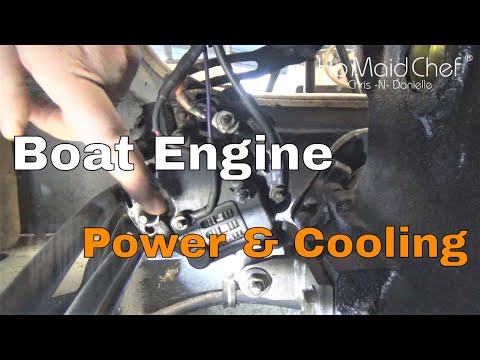
The 5.0L MerCruiser Marine V8 Donor Guide
When searching for a donor engine for a project car, most enthusiasts scour the local u-pull-it yards for wrecked Silverados or rotted-out Camaros. However, some of the most meticulously maintained and technically complete powerplants aren't sitting in a scrapyard—they're floating in a marina.
The 5.0L (305 cubic inch) V8 has long been the reliable middle brother of the Chevrolet Small Block family. While it lacks the raw displacement of the 350 (5.7L), the marine-spec 5.0L Multi-Port Injection (MPI) engines found in MerCruiser catalogs represent a fascinating and often overlooked opportunity for the savvy builder.

More Than Just a Bare Block
The biggest mistake an automotive enthusiast can make when evaluating a marine donor is treating it like a junkyard long block. In a car, the engine is one component of a massive vehicle. In a boat, the engine is part of a self-contained, highly integrated propulsion system.
When you find a 'dead hull'—a boat with structural rot or damage that makes it unseaworthy—that still houses a functional 5.0L drivetrain, you aren't just looking at an engine. You are looking at a complete engine operating system.
MerCruiser 5.0L MPI units were designed to be plug-and-play modules. To ensure reliability miles from shore, these engines were equipped with:
- Dedicated ECMs (Engine Control Modules): Ruggedized computers programmed for constant-load environments.
- Complete Marine Wiring Harnesses: Built to withstand moisture and vibration.
- Integrated Sensor Arrays: Designed to communicate directly with the proprietary ECM.
- Electronic Throttle and Ignition Systems: Highly precise components that manage idle strategy and timing.
The Take Everything Rule
If you are pulling a 5.0L from a boat, the golden rule is: Do not leave the wiring behind.
In the world of modern fuel injection, the computer is the brain that makes the heart beat. If you remove the computer and the harness, you have effectively lobotomized the engine. Re-integrating a bare marine block into an automotive or standalone application requires expensive aftermarket controllers or a deep-dive into factory automotive EFI conversions.

By taking the engine, ECM, harness, sensors, throttle, ignition, and accessories, you retain the ability to make the engine run exactly as it did in the water. From there, you can decide what to keep. A marine ECM may be perfectly appropriate for a marine restoration, while an automotive control system may be preferable for a street project. However, having the complete original harness makes the transition significantly easier for a fabricator.
Marine vs. Automotive: The Technical Divide
Before you bolt a MerCruiser 5.0L into a C10 pickup or a G-Body, there are critical differences to understand. Manufacturers like MerCruiser didn't just take a truck engine and paint it black; they adapted the Small Block Chevy for a specific duty cycle.
The Camshaft Profile Marine engines are designed for low-end torque and sustained high-RPM operation. More importantly, marine cams are ground to prevent 'exhaust gas reversion,' a phenomenon where water could be sucked back into the cylinders through the exhaust manifold.
The Cooling System Most marine 5.0Ls use 'raw water' cooling (drawing water directly from the lake) or a 'closed' heat exchanger system. For an automotive swap, you must replace the marine water pump with a standard automotive belt-driven pump and install a traditional thermostat housing.
Safety Components Marine starters, alternators, and distributors are 'spark-arrested' to prevent stray sparks from igniting fuel vapors in a cramped engine bay. While these are high-quality parts, they are often bulky and can be replaced with standard automotive versions to save space and weight.
The Intake and Fueling The MPI (Multi-Port Injection) systems found on later 5.0L marine engines are robust and efficient. However, if your project is for the street, you will need to evaluate whether the marine ECM fuel maps—designed for a boat's constant-load environment—will translate well to the variable loads of a car. In many cases, an automotive ECM swap is preferable for street drivability, but the marine hardware like injectors and rails remain top-tier.
Why the 5.0L Marine Donor is a Bargain
The 5.0L is often ignored by the performance crowd in favor of the 5.7L or the 6.2L LS-based engines. This displacement snobbery works in the favor of the budget builder.
A 5.0L MerCruiser is often better maintained than a 5.0L from a high-mileage van. Boat owners tend to perform seasonal maintenance, and because boats are luxury items, they often have significantly fewer operating hours than a work truck has miles.

Furthermore, the 5.0L block shares the same external dimensions and mounting points as the 350. This means it will bolt up to nearly any GM transmission—from a TH350 to a 4L60E—making it an easy fit for classic Chevy restorations where reliability is the primary goal.
Practical Considerations
When evaluating a marine donor, check for 'saltwater rot' if the boat was used in coastal areas. Saltwater can corrode internal cooling passages if the engine was not properly flushed. However, for freshwater boat donors, you are often getting a 'time capsule' engine that has been protected from road salt and grime for decades.
The next time you see a listing for a 'Project Boat - Engine Runs,' don't scroll past. That 5.0L V8 and its sophisticated EFI system might be the perfect, low-cost heart for your next automotive project. Just remember: take the wires, take the computer, and take the accessories. In the modern era of swaps, the complete donor is king.
By Curtis Castiglione



No Comments Yet
Be the first to comment on this article.