Curtis.Castiglione@ROzebra.com

Stellantis Suspension Diagnostics Guide (2001–2026)
If you have ever been driving your Jeep Wrangler down a washboard road and felt like the steering wheel was trying to jump out of your hands, or if you have pulled your Ram 1500 into the driveway only to notice it is leaning heavily to one side, you are experiencing the real-world symptoms of suspension wear.
Over the last 25 years, the suspension systems in Dodge, Chrysler, Jeep, and Ram vehicles have transitioned from simple mechanical designs into highly complex electronic systems. While this evolution has made our rides smoother and our trucks more capable, it has also made diagnosing problems a bit more like detective work. As a technician, I have seen the shift from the traditional 2001 leaf springs to the 2026 adaptive electronic dampers. Here is how to translate what you are feeling into a professional diagnosis.
The 'Clunk' and 'Crunch': LX Platform Sedans
One of the most common complaints I hear from owners of Dodge Chargers, Challengers, or Chrysler 300s is a persistent clunking or rattling noise when driving over small bumps at low speeds.
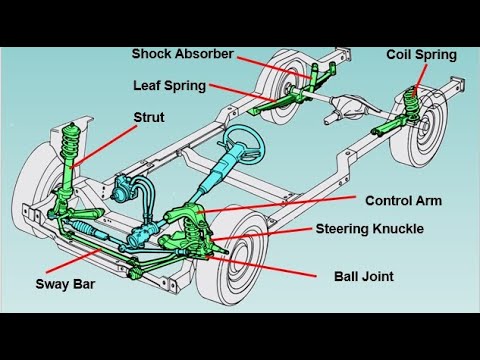
The Technician's Perspective: Since the introduction of the LX platform in 2005, these vehicles have utilized a sophisticated multi-link front suspension. This design provides excellent handling, but it creates several pivot points that can develop 'play.' That clunk is often the sound of a failing tension strut or a worn-out ball joint. When the rubber bushings crack or the internal grease dries out, you lose that tight, factory feel. If you hear a 'crunching' sound over speed bumps, you are likely looking at hardened stabilizer bar bushings. These are simple rubber parts, but once they lose their elasticity, they stop cushioning the sway bar, leading to an annoying metal-on-rubber groan.
The 'Morning Lean': Air Suspension Failure
A real-life symptom often reported by Ram 1500 and Jeep Grand Cherokee owners is finding their vehicle sitting low on its haunches in the morning, only to have it rise back up once the engine starts. You might also notice a constant humming noise coming from the front end long after you have parked.
The Technician's Perspective: Stellantis utilizes advanced air systems like Quadra-Lift and Active-Level Four Corner Air. A sagging vehicle indicates a leak in the air springs (bags) or the pneumatic lines. The humming you hear is the air compressor working overtime to compensate for that leak. This is a 'fix it now' situation. If the compressor burns out because it is running constantly, a relatively simple bag replacement turns into a much more expensive repair involving the entire electronic management block.

The 'Wander' and 'Death Wobble': Solid Axle Jeeps
If your Jeep Wrangler feels like it is 'wandering' or requires constant steering corrections just to stay in a straight line on the highway, it is not just 'a Jeep thing'—it is a component thing.
The Technician's Perspective: On solid-axle vehicles like the Wrangler TJ, JK, and JL, the track bar and drag link are responsible for keeping the axle centered under the frame. When the bushings at these connection points wear out, you get a 'flighty' steering sensation. In extreme cases, this leads to the infamous 'death wobble,' where the front end vibrates violently after hitting a bump. We check for any movement in these joints; even a millimeter of play can translate to a terrifying experience at highway speeds.
The 'Floaty' Feel: Performance Adaptive Damping
In high-performance models like the Dodge Hellcat or Jeep Trackhawk, you might notice the car feels 'floaty' or takes too long to settle after hitting a dip in the road. Conversely, the ride might suddenly feel incredibly harsh, as if you have no suspension at all.
The Technician's Perspective: These vehicles use adaptive damping systems that adjust shock valving in milliseconds based on your drive mode (Street, Sport, or Track). If the electronic sensors or the internal valves fail, the system may default to its firmest setting for safety, or lose its ability to control body roll entirely. This ruins the balance of a high-horsepower vehicle.

The Technician’s 'Cheat Sheet' for Owners
Before you head to the shop, perform these two quick checks to gauge the severity of your issue:
- The Bounce Test: Push down hard on one corner of the vehicle and let go. If the car bounces more than once or twice before leveling out, your shocks or struts have lost their hydraulic dampening ability.
- The Tire Inspection: Look for 'cupping'—these are scalloped, flat spots worn into the tire tread. This is a sign that your suspension is allowing the tire to bounce down the road rather than maintaining constant contact.
Summary for Your Mechanic
When you drop your vehicle off, being specific can save you hours in labor costs. Tell your mechanic:
- When it happens: Does it clunk only when turning left, or only when the temperature is below freezing?
- Where it comes from: Do you feel it in the steering wheel or the seat of your pants?
- Recent changes: Did the symptoms start after an off-road trip or after hauling a heavy trailer?
Modern Stellantis vehicles are engineering marvels, but they still rely on the laws of physics. Keeping your suspension tight ensures that whether you are in a 2001 Ram or a 2026 Charger Daytona, your vehicle continues to handle exactly the way the engineers intended.



No Comments Yet
Be the first to comment on this article.