Curtis.Castiglione@ROzebra.com

Salvaging GM V8 Engines from Abandoned Boats
In the world of engine swapping and hot-rodding, the local pick-and-pull junkyard is the traditional hunting ground. Enthusiasts spend hours scouring rows of crashed Silverados and rotted Suburbans for a target LS or Big Block. However, there is a massive donor market that remains largely ignored by the automotive world: the dead recreational boat.
Across the country, thousands of boats sit behind garages, in storage lots, and on cheap classified sites with a familiar description: 'Needs work.' In the boating world, that phrase is often a death sentence for the hull. But for the engine hunter, it is an invitation to acquire a high-nickel GM V8 and a mountain of heavy-duty components for a fraction of the cost of a crate engine.

The Unusual Economics of the Boat Donor
A car's value is intrinsically linked to its ability to be driven. Once a car’s floorboards rot out or its frame snaps, the entire vehicle is usually headed for the crusher. A boat follows a different trajectory.
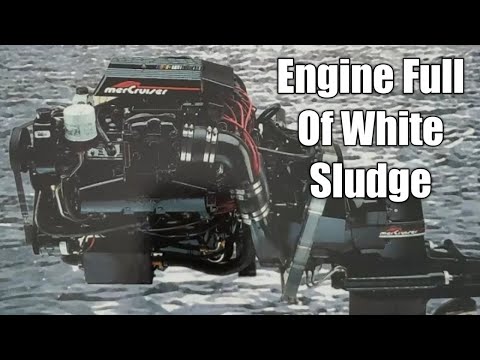
A boat can become nearly worthless while the powertrain remains in excellent mechanical condition. A 1988 Bayliner or Sea Ray with a water-damaged interior and a delaminated fiberglass hull is a liability to a boater—it is expensive to store and even more expensive to repair. However, if that boat is powered by a GM-based Mercruiser or Volvo Penta 5.7L (350ci) or 7.4L (454ci) V8, the mechanical value remains high.
Consider the math:
- $1,500 boat: A questionable purchase for someone looking to spend a weekend on the lake.
- $1,500 mechanical package: An incredible deal for a builder who needs a V8, a heavy-duty trailer, and a suite of gauges.
Understanding the Marine V8: More Than Just a 350
It is a common misconception that marine engines are identical to their automotive counterparts. While the blocks and cylinder heads often share the same casting numbers, the internal recipe is frequently different due to the duty cycle.
A car engine spends most of its life at 2,000 RPM with very little load. A boat engine, however, is under constant load—it is essentially like driving a truck up a 6% grade at 4,000 RPM while pulling a trailer for hours at a time. To survive this, marine GM V8s often featured:
- High-Nickel Castings: Better heat dissipation and durability.
- Heavy-Duty Internals: It is common to find four-bolt main caps and forged components in marine engines that would have had two-bolt mains in a passenger car.
- Brass Freeze Plugs: Unlike the steel plugs in automotive engines, marine engines use brass to prevent corrosion from raw water cooling.
- Camshaft Profiles: Marine cams are ground for high low-end torque and to prevent reversion (drawing water back into the exhaust).
The 5.7L Small Block and 7.4L Big Block Staples
Most GM-powered boats from the 1970s through the early 2000s will feature either the 350 Small Block or the 454 Big Block.
The 350 is often found with Mercruiser 260 or 5.7L logos. These are generally standard-rotation engines that can be dropped into a C10 or Camaro with minimal changes.
The 454 units are the real prizes. While the 454 disappeared from passenger cars in the mid-70s, it remained the king of the water through the 90s. These often include the high-torque 'peanut port' heads or, in higher-performance packages, large-oval port heads. By 1991, these transitioned to the Gen V architecture, and by 1996, the Gen VI Vortec 7400 arrived with hydraulic roller camshafts.

Look Beyond the Long Block: The Hidden Parts List
When you buy a donor boat, you are not just buying an engine; you are buying a complete mechanical ecosystem. Many of these parts are high-quality and can be sold to recoup costs or repurposed:
- Fuel and Spark: Marine carburetors like the Rochester Quadrajet or Holley 4160 are 'J-vented' to prevent fumes from escaping into the bilge. They are excellent, heavy-duty units for off-road or street use.
- Electrical: Marine starters and alternators are ignition protected to prevent sparks. While they are bulky, they are incredibly robust.
- Instrumentation: High-quality VDO or Teleflex gauges for oil pressure, temperature, and RPM can be repurposed for a custom dashboard.
- The Trailer: This is the most overlooked part. A boat trailer can often be sold for $500–$1,000 alone, or it can be converted into a flatbed car hauler or utility trailer.

The Inspection: Avoiding the Anchor
A $500 boat is only a bargain if the engine is not a solid block of rust. Before you hook up the trailer, you must perform a focused inspection:
The Freeze Crack Test This is the most common killer of marine engines. If a boat was not winterized correctly, water trapped in the block would freeze and crack the casting. Look specifically along the lifter valley and the outside of the block under the exhaust manifolds. A horizontal crack in the casting means the block is junk.
The Breaker Bar Test Never buy a donor engine without seeing if it rotates. Put a socket and a breaker bar on the harmonic balancer bolt. If it does not budge, walk away—water has likely entered the cylinders via the exhaust or a blown head gasket, seizing the pistons to the walls.
Oil and Milkshakes Pull the dipstick. If the oil looks like chocolate milk, there is water contamination. This could be a simple manifold gasket leak, or it could be a cracked internal cooling passage.
Rotation Direction Warning: Some twin-engine boats use one standard rotation engine and one reverse (counter-rotating) engine. If you buy a reverse-rotation engine for a truck, the transmission will have one speed forward and four speeds in reverse. Always check the firing order and the starter rotation before purchasing.
The Strategy for the Budget Builder
The best donor vehicles are often the ones that the general public views as a nuisance. To the neighbors, that 20-foot boat with the flat tires and the faded gel coat is an eyesore. To the seller, it is a source of stress they want gone.
For the automotive enthusiast, it is a high-performance GM V8 wrapped in a shipping crate made of fiberglass. By shifting your mindset from boat buyer to mechanical harvester, you can bypass the inflated prices of the automotive salvage market and find your next project’s heartbeat sitting under a blue tarp in a backyard.



No Comments Yet
Be the first to comment on this article.