Curtis.Castiglione@ROzebra.com
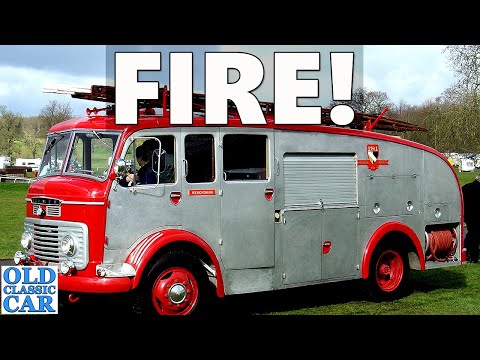
Retired Fire Trucks: Heavy-Duty Engine Donor Guide
When most automotive enthusiasts think of a donor vehicle, they picture a crashed muscle car, a rusted-out pickup truck, or perhaps a high-mileage police interceptor. However, one of the most overlooked sources for high-quality, heavy-duty components is the retired fire apparatus.
Whether it is a pumper, a ladder truck, or a brush truck, these vehicles represent a unique intersection of extreme engineering and meticulous maintenance. Because fire trucks are designed to perform under life-or-death circumstances, they are equipped with drivetrains, cooling systems, and electrical hardware that far exceed the specifications of standard commercial trucks. For the fabricator, off-road builder, or restorer, a retired fire truck is less of a vehicle and more of a dense package of industrial-grade gold.

The Fire Service Advantage: Maintenance and Environment
The fundamental appeal of a retired fire truck lies in its duty cycle. Unlike a long-haul semi-truck that might see a million miles of highway wear, or a construction dump truck that lives in a cloud of abrasive dust, a fire truck spends most of its life in a climate-controlled station.
Furthermore, fire departments operate on a culture of zero failure. When a fire truck moves, it is driven hard, but it is serviced with an almost religious devotion to preventative maintenance. This makes them a fascinating category for builders looking for medium-to-heavy-duty diesel engines and robust transmissions that haven't been neglected.
The Engine Room: From Gas Giants to Diesel Legends
Fire apparatus engines are designed for two things: moving immense weight quickly and powering high-volume pumps for hours on end. Depending on the era, you can find legendary power plants that are difficult to source elsewhere.
The Gasoline Era (1960s–1970s)
If you are hunting for massive displacement gasoline engines for a period-correct heavy restoration or an industrial project, look to fire trucks from the '60s and '70s.
- Ford Chassis: Often utilized the 534-cubic-inch Super Duty V8. These are incredibly robust, overbuilt engines designed for maximum torque.
- International Harvester: Frequently carried the 401, 478, or 549-cubic-inch V8 gas engines. While thirsty, these engines are iconic for their durability.
The Two-Stroke Diesel Era
As the industry shifted toward diesel in the 1980s, fire trucks became a primary home for the Detroit Diesel two-stroke engines.
- The 6V71, 8V71, and 6V92 Silver Series: These engines were staples in apparatus produced by companies like Pierce and Seagrave.
- The Appeal: The 6V92, for instance, produces significant horsepower and possesses a distinct, screaming exhaust note that enthusiasts crave.
- The Caveat: Be aware that fire-spec Detroits were often tuned for high output to meet emergency response times, which can affect long-term longevity if they were pushed to their absolute limits during every call.

The Modern Diesel Holy Grail
In the 1990s and 2000s, Cummins and Caterpillar took over the engine bays.
- Cummins 8.3L 6CT: This is often considered the Big Brother to the legendary 5.9L 12-valve Cummins. Unlike the 5.9L, the 8.3L features a wet-sleeve design, making it infinitely rebuildable and much sturdier. Earlier models feature the highly desirable mechanical P-pump, making them an incredible candidate for a heavy-duty repower of a motorhome or a large off-road vehicle.
- Caterpillar 3208: Found in many 1980s-era trucks, this compact V8 diesel is a non-sleeved engine, but its ubiquity and size make it a relatively straightforward swap for medium-duty applications.
Transmission and Drivetrain: The Allison Advantage
One of the strongest arguments for acquiring a retired fire truck is the transmission. You won't find light-duty pickup truck automatics here. Instead, you get world-standard commercial units, specifically from Allison.
- The MD3060 and 4000-Series: These are six-speed overdrive transmissions capable of handling massive torque loads.
- PTO Capability: In fire applications, these transmissions are almost always paired with robust Power Take-Off (PTO) units. For a custom builder, this PTO can be repurposed to run hydraulic winches, heavy-duty lifts, or even onboard generator systems.
- Axles and Brakes: It is common to find Rockwell or Dana-Spicer rear ends. While the gear ratios are often short (optimized for getting a 30,000-pound truck moving quickly), the housings and shafts are nearly indestructible.
Oversized Systems: Electrical and Cooling
Fire trucks are essentially mobile power plants. They must run high-intensity lighting and radio arrays for hours while stationary.
- Alternators: They are often equipped with Leece-Neville or Delco Remy high-output alternators, sometimes producing 200 to 320 amps at idle. This is a massive upgrade for expedition vehicles or van-life builds requiring significant off-grid power.
- Cooling: Fire truck radiators are massive. They are designed to keep an engine cool while it is under full load (pumping water) without the benefit of airflow from vehicle movement. If you have a custom tow rig that struggles with overheating, a fire apparatus cooling stack is the ultimate solution.

The Critical Evaluation: Miles vs. Hours
The most important lesson in evaluating a fire truck as a donor is the Hours vs. Miles rule.
A fire truck might show only 20,000 miles on the odometer, which suggests a nearly new engine. However, the hour meter might show 5,000 hours. A significant portion of those hours may have been spent at high RPMs to power the water pump.
The Rule of Thumb: Fleet managers generally calculate that one hour of engine time is roughly equivalent to 30 to 50 miles of highway driving.
- High Hours/Low Miles: Expect wear on engine bearings, valves, and the cooling system.
- Low Hours/Low Miles: This is the unicorn donor vehicle, likely a support vehicle or a chief’s rig.
Practical Considerations for the Donor Hunter
Acquiring these vehicles is usually done through municipal auctions. Because fire trucks are so specialized—the bodies are integrated into the chassis and aren't easily converted for hauling freight—they have poor resale value to the general public.

This uselessness is the donor hunter’s greatest advantage. You are often bidding against scrap yards. If you can outbid the price of the raw steel, you can walk away with a world-class drivetrain for a fraction of what those components would cost individually.
A Final Warning on Frames: Many custom fire chassis use double-channel frames (a frame rail nested inside another). While incredibly strong, these can be a nightmare for rust in salt belt states, as moisture gets trapped between the two layers of steel. Always inspect the frame rails for scaling or swelling between the layers before committing to the purchase.
In summary, retired fire apparatus are dense packages of high-specification mechanical components. For the builder who needs a Cummins 8.3L, an Allison 3000-series transmission, and a charging system that can power a small house, the local municipal auction might be the most important performance shop in town.



No Comments Yet
Be the first to comment on this article.