Curtis.Castiglione@ROzebra.com

Industrial Gem: The Ford 300 Wood Chipper Donor
By Curtis Castiglione
If you are looking for a Ford 300-cubic-inch (4.9L) inline-six to power a rugged off-road build, a reliable farm truck, or a unique rat rod, your first instinct is likely to scour the local junkyard for a 1970s F-150 or a rotted-out Econoline van. However, as the popularity of these "unkillable" engines grows, the prices for donor trucks have climbed steadily.
There is, however, a source of these engines that most automotive enthusiasts walk right past: the industrial wood chipper.
For decades, Ford Power Products produced industrial versions of the 300 inline-six. While the automotive world moved toward V8s and eventually smaller V6s, the industrial world clung to the 300 because of its legendary torque curve and its ability to run at a constant load for thousands of hours without failure. If you see an old Asplundh or Morbark chipper sitting in a municipality auction or a back lot, you might be looking at a low-mileage, heavy-duty treasure chest.

The Industrial Pedigree: Why the 300?
The Ford 300 is famously overbuilt. With seven main bearings and a gear-driven camshaft (no timing chain or belt to snap), it was designed for durability. In a truck, this meant it could survive a teenager’s abuse or a contractor’s neglect. In a wood chipper, these characteristics were even more vital.
A wood chipper engine does not experience the variable RPM of a highway commute; instead, it lives its life at a "steady state." It is fired up, brought to a specific operating speed (governed), and then subjected to high-torque "hits" as logs are fed into the blades. Because of this, industrial 300s were often maintained on strict hourly schedules and equipped with heavy-duty components that surpass standard passenger truck specifications.
The "Industrial Trap": Identifying the Differences
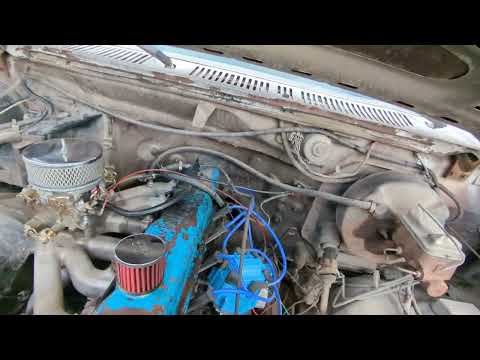
Before you hook up a trailer to haul home a rusted chipper, you must understand that "industrial" does not mean "identical." Ford produced these engines with specific hardware tailored for stationary use. If you plan to drop a chipper engine into a 1966 F-100, you need to be prepared for the following differences:
- The Governor: Most industrial 300s are equipped with a mechanical governor designed to maintain a specific RPM regardless of load. For a vehicle, this must be removed or bypassed to allow for a traditional throttle response.
- The Bellhousing and Flywheel: This is the biggest hurdle. Many industrial engines use an SAE (Society of Automotive Engineers) housing to connect to hydraulic pumps or belt-drive clutches. This is completely different from the Ford "Small Block" bolt pattern found on F-150 transmissions (C6, M5OD, or T-18). You may need to source a truck-specific bellhousing, flywheel, and starter to make the engine work with a standard transmission.
- The Cooling System: Industrial engines often utilize massive, high-capacity radiators and different water pump pulleys designed for stationary airflow rather than the ram-air cooling of a moving vehicle.
- Distributors and Ignition: Depending on the year, a chipper engine might use a simplified electronic ignition or even a magneto system on very old units. You will likely want to swap this for a standard Duraspark II or a modern HEI distributor.
- Manifolds and Exhaust: Wood chipper exhaust manifolds are often designed to exit vertically or in odd directions to clear the chipper frame. These rarely clear the firewall or steering box of a car or truck, meaning you will need to source automotive manifolds or headers.
Why the Chipper is a High-Value Donor
Despite the technical hurdles of the swap, the industrial 300 offers several advantages that make it a superior donor to a high-mileage pickup:
- Low Internal Wear: While a truck engine may have 200,000 miles of cold starts, gear-grinding, and highway overheating, a chipper engine is measured in hours. Many of these engines have spent their lives at a constant, optimal operating temperature, which results in significantly less cylinder wall and bearing wear.
- Heavy-Duty Internals: Some industrial versions of the 300 were rumored to have forged crankshafts or specific heavy-duty valves and seats to handle the heat of constant-load operation. While this varies by the specific "SO" (Special Order) number of the engine, the base casting is almost always the "heavy-duty" version of the block.
- The "Free" Extras: When you buy a chipper for its engine, you are not just getting the block. You are getting a heavy-duty radiator, a high-output alternator (often 100+ amps to power work lights), and sometimes a PTO (Power Take-Off) clutch system that can be sold to other industrial users to recoup the entire cost of the purchase.
Evaluation and Acquisition
When evaluating a wood chipper donor, focus on the Ford Industrial ID plate, usually located on the side of the engine or the valve cover. Look for the 4.9L or 300 CID designation.
- The Carburetor Check: Most industrial 300s used a rugged, simple single-barrel carburetor. If it is a later model (post-1987), it may still be carbureted even though the trucks had moved to Fuel Injection. This makes them a "holy grail" for builders who want a late-model block without the complexity of an ECU and wiring harness.
- The Front Cover: Check the front timing cover. Industrial engines often have unique accessory drive setups for hydraulic pumps. Ensure the block has the mounting bosses necessary for the alternator and power steering brackets you intend to use.

Final Thoughts
The Ford 300 is a masterpiece of American engineering, and as the supply of clean donor trucks dwindles, the "wood chipper secret" is becoming more valuable. By looking at a chipper as a donor, you are often getting a better-maintained, lower-wear engine for a fraction of the price of a "classic" truck engine.
Document the configuration, be prepared to swap the bellhousing and accessories, and you will find that the heart of a 1980s Asplundh chipper is more than ready for another 300,000 miles on the road or the trail.



No Comments Yet
Be the first to comment on this article.