Curtis.Castiglione@ROzebra.com
Industrial and Motorhome Engine Donor Guide
For decades, the ritual for sourcing a project engine has remained the same: trek to the local salvage yard, find a high-mileage pickup truck, and hope the previous owner changed the oil at least once a decade. But for the savvy builder, there is a better way.
While most enthusiasts are scouring the truck rows, a treasure trove of low-mileage, heavy-duty hardware is hiding in plain sight—tucked inside obsolete standby generators and parked behind the fiberglass shells of aging motorhomes. These industrial donors often provide a level of internal freshness that a 200,000-mile Silverado simply cannot match.
The Secret Life of the Standby Generator
The primary advantage of a generator-set (gen-set) engine is simple: low hours. While a truck engine accumulates wear through stop-and-go traffic, cold starts, and varying loads, a standby generator spends 99 percent of its life sitting in a climate-controlled or weather-protected enclosure. Its only job is to wait. When it does run, it usually operates at a constant, governed RPM (often 1,800 or 3,600 RPM), which is far less stressful than the erratic revving of street use.

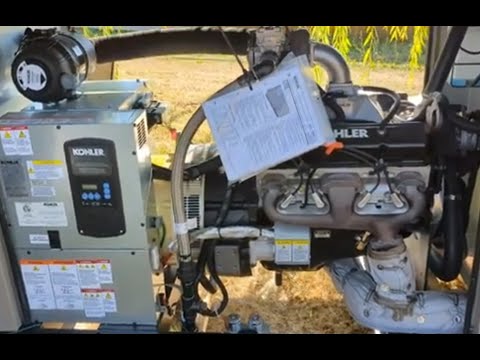
Consider a documented example of a 2008 Kohler 48-kW unit. This industrial machine was equipped with a GM 5.0L V8 but showed only 109 recorded hours. In automotive terms, that engine is barely broken in. By comparison, a 2008 Chevy Tahoe in a junkyard likely has 4,000 to 6,000 hours of operation on its clock.
When evaluating a generator engine, look at the fuel source. Many of these units run on Natural Gas (NG) or Propane (LPG). These fuels burn significantly cleaner than gasoline, resulting in:
- Virtually no carbon buildup on valves or piston tops.
- Less oil contamination and dilution.
- Greatly reduced wear on cylinder walls.
The Motorhome Goldmine: Big-Block Power
If you need displacement rather than a small-block, the focus shifts from the generator shed to the RV lot. Class A and Class C motorhomes built on the Chevrolet P30 chassis or Ford F53 chassis are the ultimate sources for big-block muscle.

The GM 454 (7.4L) V8
From the 1970s through the late 1990s, the 454 was the workhorse of the motorhome world. Because RVs are luxury items used for vacations, it is common to find a 1990s Winnebago with under 50,000 miles.
- 1990–1995 (Gen V): These introduced the one-piece rear main seal and four-bolt mains, providing a stout foundation.
- 1996–2001 (Gen VI/Vortec 7400): These are the holy grail of industrial donors. They typically feature hydraulic roller camshafts and significantly improved cylinder head airflow.
- The Peanut Port Reality: Most motorhome 454s use small-oval peanut port heads. While drag racers might swap them, off-roaders and tow-rig builders prize them for their incredible low-end torque and high intake velocity.

The Ford 460 (7.5L) V8
Ford kept the 385-series 460 in the motorhome chassis (E-350 and F53) long after it vanished from passenger cars. These engines are torque monsters, often equipped with heavy-duty cooling packages, including massive external oil coolers and high-flow water pumps that are highly desirable for performance builds.

Heavy-Duty Transmissions and Hardware
The donor value extends far beyond the long block. Motorhomes and industrial units are often equipped with the strongest transmissions available from the factory.
- The GM 4L80E: Found in most 1990s GM-based motorhomes, this is the electronic version of the legendary TH400. Sourcing one from an RV often nets you a unit with low mileage and factory-installed heavy-duty internal hard parts.
- The Ford E4OD and 4R100: These are the strongest automatics Ford offered in the 1990s. Note that motorhome versions often use a fixed yoke or a transmission-mounted parking brake. While this requires a different driveshaft setup, the internal planetary gears are often superior to light-truck versions.
- Hydro-Boost Systems: Most large RVs use hydraulic-assist braking rather than vacuum. This Hydro-boost unit is a bolt-in upgrade for hot-rodders with high-overlap cams that do not produce enough vacuum for traditional power brakes.
Practical Considerations Before You Buy
Industrial hunting requires more technical due diligence than a standard engine swap. You are not just buying a car; you are salvaging a specialized piece of equipment.
- Interchangeability: Not every part is a direct swap. You must verify if the engine is a Tall Deck (like the GM 366 or 427 industrial engines). Tall deck engines have a higher deck height, meaning standard intake manifolds and headers will not fit. Stick to the 7.4L (454) or 7.5L (460) for the best compatibility.
- The Sitting Penalty: An engine with 100 hours that has sat for 10 years may have dried-out valve stem seals or a rusted fuel rail. Plan on a full gasket kit and fuel system flush before the first fire-up.
- Engine Controls: Generator engines may use unique ECMs (Electronic Control Modules) designed to hold a steady RPM. For a vehicle swap, you will likely need to swap to an automotive-style wiring harness and ECU to handle varying throttle positions.
- Extraction: Removing an engine from a Class A motorhome is a surgical procedure. You may have to remove the seats and floorboards or cut the front fiberglass cap off entirely. It is not a job for a beginner with a basic tool kit.
Summary: The Builder’s Edge
The smart enthusiast understands that the best donor is not necessarily the one that looks like a car. Whether it is a Kohler generator with a nearly-new 5.0L GM heart or a Fleetwood RV housing a low-mileage 460 Ford, these unconventional sources offer time-capsule internals that you simply won't find in a traditional junkyard truck.
Industrial hunting takes more research—checking casting numbers, verifying sensor compatibility, and navigating heavy-duty cooling setups—but the reward is a high-strength, low-wear foundation for your next project.
Written by Curtis Castiglione



No Comments Yet
Be the first to comment on this article.