Curtis.Castiglione@ROzebra.com

Hidden Power: Harvesting Heavy-Duty V8s from Industrial and Commercial Donors
When a car enthusiast walks through a junkyard or scrolls through local classifieds, their eyes naturally gravitate toward the silhouettes of muscle cars and classic trucks. However, some of the most robust and high-displacement engines ever produced are hidden inside vehicles that most people would never consider performance platforms.
To the savvy builder, a rusted-out forklift or a retired hearse isn't just scrap metal—it is a donor vehicle. By looking past the muscle car tax applied to famous nameplates, you can find heavy-duty components and massive displacement engines for a fraction of the cost.
The Industrial Chrysler 318: A Small Block with a Blue-Collar Resume
The Chrysler 318, part of the LA engine family, is a legend of reliability, found in millions of Darts, Coronets, and D-Series pickups. However, while the passenger-car versions were cruising the suburbs, the Chrysler LH318 industrial version was working for a living in the harshest environments imaginable.

Where to Find the Industrial 318
These engines were the backbone of heavy machinery from the late 1960s through the 1980s. Seek out:
- Forklifts: Clark and Silent Hoist models.
- Equipment Handlers: Lull rough-terrain handlers and Marine Travelifts.
- Industrial Machinery: Wood chippers and stationary power units.
Why the Industrial Donor is Worth It
For a Mopar builder, an industrial machine with a dead hydraulic system or a damaged mast is a "worthless" piece of equipment that contains a high-quality engine core. These engines were designed for continuous-duty cycles, meaning they were built to run at steady RPMs under load for hours on end.
Key Technical Considerations:
- The Component Swap: Do not assume an industrial 318 is a drop-in for a Dodge Challenger. Industrial applications often use unique exhaust manifolds to clear heavy machinery frames. These may not fit a car’s engine bay.
- Accessory Drives: Water pumps, alternators, and pulleys are often application-specific. Treat the industrial unit as a long-block core. You will likely need to swap on automotive-style brackets and intake systems.
- The Core Advantage: Because these machines were often maintained by fleet mechanics on a strict schedule, the internal components are often in surprisingly good shape compared to a high-mileage passenger car engine that has been neglected for 40 years.
The Cadillac 500: Finding Displacement in the Macabre
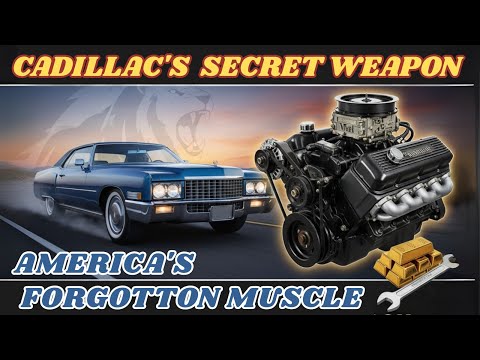
If your goal is pure, unadulterated torque, the Chevrolet 454 and Chrysler 440 are the usual suspects. But they carry a premium price tag. If you want the Displacement King, you need to look at the Cadillac 472 and 500 cubic-inch V8s produced between 1968 and 1976.
While these powered the luxury land yachts of the era, they were also the standard engine for Commercial Chassis vehicles: hearses, flower cars, and ambulances.
Identifying the Torque Monsters
- 472 cubic-inch (7.7L): Standard from 1968–1974.
- 500 cubic-inch (8.2L): Exclusive to the front-wheel-drive Eldorado from 1970–1974; became available in all models in 1975 and 1976.
The Hearse Advantage
Hearses and ambulances are excellent donors because they were over-built to handle the weight of heavy coachwork.

- Heavy-Duty Cooling: These vehicles almost always feature massive radiators and high-flow cooling systems.
- The Built TH400: The Turbo-Hydramatic 400 transmissions found in Cadillac commercial chassis often feature more clutch plates and different valve body calibrations than standard versions, making them the ultimate RWD automatic core.
- Weight Efficiency: Surprisingly, a Cadillac 500 V8 weighs only about 60 lbs more than a Small Block Chevy 350. It is significantly lighter than a Big Block Chevy or a Chrysler 440, offering a much better power-to-weight ratio for swaps.
Technical Interchange and Challenges
When harvesting a Cadillac big block, pay attention to these three factors:
- Cylinder Heads:
- 1968–1973 (Castings 950, 250, 902): These have 76cc combustion chambers and are the choice for high-compression performance builds.
- 1974–1976 (Castings 493, 120): These have 120cc chambers. They offer lower compression (approx. 8.25:1), which is ideal for budget-friendly turbocharging or low-octane workhorse towing applications.
- Oil Pan Configuration:
- Eldorado Donors: Use a rear-sump oil pan to clear the FWD transaxle. If you are swapping into a RWD truck or muscle car, the Eldorado pan is usually required to clear the front crossmember.
- Sedan/Hearse Donors: Use a front-sump pan, which is harder to fit into most common swap candidates.
- The Accessory Drive: Cadillac used a unique front-mounted distributor and oil pump. This can create clearance issues with steering racks and radiator fans. Ensure you measure your engine bay before committing to the swap.
Final Thoughts for the Builder
The Muscle Car Era wasn't limited to the showroom floor; it extended to the job site and the funeral procession. Whether it’s the Chrysler LH318 from a wood chipper or a Cadillac 500 from a 1973 hearse, these overlooked donors offer a torque per dollar ratio that is hard to beat.
When evaluating these vehicles, look past the rust and the unconventional bodywork. Behind the forklift mast or the velvet curtains of a hearse lies a heavy-duty powertrain designed for a lifetime of work—and ready for a second life in your project.
Written by Curtis Castiglione



No Comments Yet
Be the first to comment on this article.