Curtis.Castiglione@ROzebra.com
Ford 5.0L Industrial and Marine Donor Guide
Written by Curtis Castiglione
The Ford 5.0L V8 is arguably one of the most recognizable engine displacements in American history. Mention the Five-Oh to any car enthusiast, and their mind immediately goes to the 1980s Fox-body Mustang, the five-point-slow trucks of the 90s, or perhaps the modern, high-screaming Coyote. Because the engine is so familiar, many buyers assume that every 5.0L is created equal. They believe that a 302-cubic-inch displacement serves as a universal guarantee of performance or interchangeability.
They are wrong.
The Ford 5.0L (specifically the Windsor-based 302) has lived a double life. Beyond the local car meet, there is a massive population of these engines serving in roles that have nothing to do with drag strips or stoplight rallies. From the bellies of fiberglass boats to the heart of industrial wood chippers and backup generators, the 5.0L has an industrial afterlife that offers a savvy builder an entirely different market for high-quality donor parts.

The Industrial Reservoir: Ford Power Products
While enthusiasts were buying Mustangs and F-150s, Ford’s Power Products division was selling the 5.0L platform to manufacturers of stationary and commercial equipment. This is where the detective work begins.
In industrial applications—such as irrigation pumps, large-scale wood chippers, and stationary electrical generators—the 5.0L was chosen for its compact size and legendary reliability. These engines were often configured to run at a constant RPM for hours on end.
Why these are prime donors:
- Maintenance Cycles: Industrial equipment is often maintained on a strict hourly schedule, regardless of mileage.
- Internal Condition: Because many of these engines ran at a constant, governed RPM, they avoided the high-stress stop-and-go cycles and redline shifts typical of a passenger car.
- Fuel Varieties: Many industrial 5.0Ls were set up for Propane (LPG) or Natural Gas. These fuels burn much cleaner than gasoline, often leaving the internal components—valves, pistons, and cylinders—in pristine condition even after years of service.

The Marine Market: High Performance in Hiding
If you are looking for high-performance GT40 style components, don't just look for a 1993 Mustang Cobra or a Ford Explorer. Look at the water.
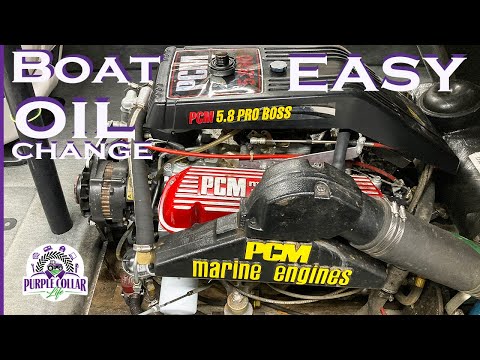
Companies like MerCruiser, OMC, and Volvo Penta used the Ford 302/5.0L extensively in sterndrive and inboard applications. Because a boat engine operates under a constant uphill load (similar to a truck towing a trailer up a permanent grade), the marine versions of the 5.0L often featured the best of the best factory parts to ensure survival.
- The GT40 Connection: Many marine 5.0L engines from the mid-to-late 90s came factory-equipped with the highly desirable GT40 cylinder heads. These heads offer superior flow over the standard E7TE truck heads and are a bolt-on performance upgrade for any street build.
- High-Nickel Blocks: There is long-standing debate and some evidence that certain marine and industrial blocks featured a higher nickel content for corrosion resistance and strength. While casting numbers like the XXX block are the primary way to verify this, the industrial duty cycle often demanded the sturdiest castings available.
Practical Considerations for Marine Donors:
- Rotation: Most marine engines are Standard Rotation (left-hand), but some twin-engine boat setups used Reverse Rotation (right-hand) engines. Installing a reverse-rotation crank or cam into a street car will result in a vehicle with one very fast reverse gear and zero forward gears.
- Corrosion: In raw water cooled boats, the engine pumps lake or ocean water directly through the block. If the boat was used in salt water, the internal cooling passages might be severely corroded. Always look for closed-cooling (heat exchanger) systems.
The Technical Divide: Not All 5.0Ls Are Equal
When hunting in unconventional markets, you must distinguish between the generations. The 5.0L badge was used on the Windsor pushrod engine from the late 60s through 2001, and again on the modular Coyote engine starting in 2011. For the classic 302/5.0L Windsor, pay attention to these critical specs:
- The Roller Cam Transition: In 1985 (cars) and roughly 1992 (trucks), Ford transitioned to hydraulic roller lifters. These are much more desirable for modern builds as they allow for more aggressive cam profiles with less friction. Look for the E7TE or F4TE casting marks on the block.
- Firing Order: The 5.0L High Output (HO) and the 351W use a different firing order (1-3-7-2-6-5-4-8) than the standard 5.0L/302 (1-5-4-2-6-3-7-8). If you pull an engine from an industrial generator and try to use a Mustang ECU, it may not run correctly without a cam swap.
- Balance: Most 302s produced before 1981 use a 28-oz imbalanced crankshaft. Most produced after 1982 use a 50-oz imbalance. You cannot mix and match flywheels or harmonic balancers between these two without destroying the engine's bearings.

Beyond the Block: Secondary Gold
A donor vehicle is more than just an engine. Industrial and fleet vehicles often carry heavy-duty support systems that are upgrades for a standard project car.
- High-Output Alternators: Ambulances and delivery vans often utilize 130-amp or 160-amp 3G alternators. These are a popular junk-yard upgrade for older Fords that originally came with weak 60-amp units.
- Cooling Systems: Industrial 5.0Ls often use massive, multi-row radiators and oil coolers designed to keep the engine cool while stationary.
- Hydroboost: Found commonly in F-450/550 trucks and some large vans, the Hydroboost braking system uses power steering pressure rather than vacuum. This is a must-have for hot-rodders running big cams with low vacuum.
How to Search
The enthusiast who searches for 'Mustang 5.0 engine' is competing with thousands of other buyers, driving prices up. To find the bargains, you must search for the application. Use keywords like:
- Ford Power Products V8
- Wood Chipper 8-cylinder
- 5.0L Marine Long Block
- Propane Generator Ford
- E-350 Fleet Salvage
The Verdict
Buying an engine from an old wood chipper or a decommissioned airport tug requires more legwork than buying a crate engine from a catalog. You have to check the casting numbers, verify the rotation, and potentially deal with unique accessory drives or SAE-standard bellhousing adapters.
However, the reward is often a low-wear, high-quality core that has lived a sheltered life far from the redline. By looking past the 5.0L badge and investigating the industrial application, you can find performance potential that the rest of the market has completely overlooked.



No Comments Yet
Be the first to comment on this article.