Curtis.Castiglione@ROzebra.com

Ford 240 Industrial Engine Donor Guide
While the Ford 300 cubic-inch inline-six has long been celebrated as one of the most indestructible engines ever to emerge from Detroit, its smaller-displacement sibling, the 240, often remains in the shadows. For the automotive enthusiast or budget-conscious restorer, this lack of attention is a strategic advantage. The 240 was the foundation of Ford's big six-cylinder family, produced from 1965 through 1974 in light-duty trucks and until the mid-1970s in full-size cars like the Galaxie.
However, its life extended far beyond the engine bays of F-Series pickups. Because it was a rugged, simplified, and reliable design, Ford marketed the 240 as a dedicated industrial power unit, leading it into a surprising second life inside heavy-duty machinery like the Chipmore B-702 tree chipper.
The 240 vs. The 300: A Shared Architecture
To understand why the 240 is valuable, you must understand its relationship with the 300. They share the same basic block casting, which is why they are often confused at a glance. The primary difference lies in the stroke and the connecting rods.
- Stroke: The 240 utilizes a shorter 3.18-inch stroke compared to the 3.98-inch stroke of the 300.
- Character: This makes the 240 a naturally smoother, higher-revving engine than the torque-heavy 300.
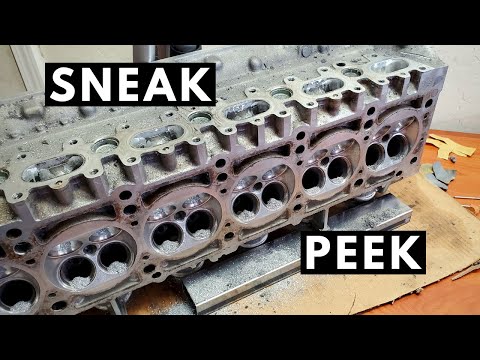
- The Cylinder Head: The 240 head features a smaller combustion chamber than the 300 head. When a 240 head is installed on a 300 block, it provides a significant bump in compression, making it a classic hot rod trick for Ford six-cylinder fans looking for easy horsepower.
Why Industrial Equipment Makes a Great Donor
Engine hunters who limit their search to automotive junkyards are missing a significant source of high-quality cores. The industrial 240 is a prime example of why looking at stationary equipment and commercial machinery can yield excellent results.
When a piece of equipment like a wood chipper or a piece of airport ground equipment is retired, it is often due to a failure in the specialized machinery itself or a lack of modern safety certifications, rather than a failure of the engine. This means a 240 found in a wood chipper might have significantly fewer "miles" in terms of internal wear compared to a truck engine that has spent decades hauling heavy loads on the highway.
The Industrial Difference: Identification and Conversion
The industrial version of the 240 requires a discerning eye because it is not a direct "drop-in" replacement for a vehicle. Manufacturers like Chipmore had specific requirements for their power units that differed from what Ford required for a pickup truck. When you find a 240 in an industrial setting, you are looking at a specialized configuration.
Common differences include:
- Governor Arrangement: Industrial engines are designed to run at a constant RPM. This usually involves a mechanical or velocity governor that limits engine speed, which must be removed for automotive use.
- Carburetor and Distributor: Industrial 240s often utilized basic, heavy-duty single-barrel carburetors and distributors with specific advance curves—or no advance curve at all—meant for stationary operation.
- Flywheel and Clutch: Many industrial engines were mated to SAE-standard bellhousings to drive hydraulic pumps. These components will not bolt up to a Ford Toploader or C6 transmission.
- Cooling and Exhaust: A chipper might have a massive radiator meant for low-airflow environments and an exhaust manifold that exits at an awkward angle for a truck engine bay.
The "Long Block" Strategy
To use an industrial 240 in a vehicle, you must be prepared to strip it down to the "long block"—the block, crank, rods, pistons, and head—and then dress it with automotive-spec parts. This includes a vehicle-specific oil pan, as industrial pans may be shaped differently to clear the frame of the machinery or to provide extra oil capacity for long duty cycles.
The reward for this extra work lies in the quality of the hard parts. Because these engines were intended for heavy-duty service, some industrial versions were equipped with premium components:
- Forged Steel Crankshafts: Some industrial units received forged cranks rather than cast units to handle the vibrations of constant high-load operation.
- Sodium-Filled Valves: Designed to dissipate heat more effectively during long duty cycles.
- Heavy-Duty Castings: The block itself is a robust, thick-walled casting that provides a stable foundation for a performance rebuild.

Final Considerations for the Hunter
The industrial 240 represents a low-competition source for a classic engine. While hobbyists are fighting over every 300 inline-six found in a 1970s F-100, the tree chipper sitting in the back of an equipment auction often goes for scrap prices.
By viewing the chipper as a core donor rather than a direct replacement, you can secure a high-quality Ford six-cylinder for a fraction of the cost. You aren't just buying an engine; you are buying a survivalist workhorse that was over-engineered for its task. With the right mix of automotive brackets, a proper distributor, and a truck-spec flywheel, that 240 can be returned to the road, proving that some of the best automotive finds aren't found in cars at all.



No Comments Yet
Be the first to comment on this article.