Curtis.Castiglione@ROzebra.com

Evolution and Diagnostics of Chevrolet Suspension (2001–2026)
If you have spent any time behind the wheel of a Chevrolet over the last twenty-five years, you know that the "Chevy feel" is a broad spectrum. It ranges from the cloud-like, floating comfort of an early 2000s Suburban to the laser-precise, road-hugging grip of a modern Corvette C8.
But when that signature ride starts to degrade, it does not just affect your comfort—it affects your safety. As a technician, I have learned that drivers rarely walk into the shop using technical terms like "bushing deflection" or "magnetorheological failure." Instead, they tell me their truck "feels like a boat in a storm" or their SUV makes a "bone-jarring thud" over every speed bump.
Since 2001, Chevrolet suspension has evolved from simple mechanical systems into high-tech platforms where hardware and software work in tandem. If your Chevy is acting up, here is a guide to translating those real-life symptoms into a professional diagnosis.
1. The Pogo-Stick Effect (Excessive Bouncing)
The Symptom: You hit a dip in the road, and your Silverado or Equinox continues to bounce up and down three or four times before finally settling.
The Tech Perspective: This is a classic sign of worn-out dampers—your shocks or struts. In older models with traditional hydraulic shocks, internal seals eventually leak, allowing oil to bypass the valving. Without that resistance, your coil or leaf springs are left to do all the work, leading to that uncontrolled oscillation.
If you drive a newer model equipped with Magnetic Ride Control (MRC), this floaty feeling is more urgent. These systems use a specialized fluid that changes viscosity instantly via an electromagnetic field. If a sensor fails or the fluid leaks, the system often defaults to a fail-safe mode. If your dashboard displays a "Service Suspension System" message along with the bounce, the computer has detected an electronic fault that requires a diagnostic scanner to solve.
2. The Clunk, Pop, and Rattle
The Symptom: You hear a sharp clunk when turning the steering wheel or a persistent rattle that feels like it is coming from right under your floorboards when driving over small bumps.
The Tech Perspective: This is usually the language of failing ball joints, control arm bushings, or stabilizer bar links. Over the last 25 years, Chevrolet has transitioned to more aluminum suspension components to save weight. However, the rubber bushings that isolate these parts still have a shelf life. When that rubber cracks or tears, you get metal-on-metal contact.
On the Silverado and Colorado specifically, the stabilizer bar links are common culprits. These small rods connect your suspension to the sway bar; when their small joints wear out, they produce a rapid-fire rattling sound that belies their small size.
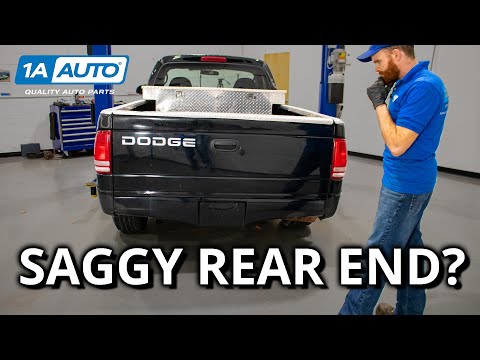
3. The Morning Lean (Air Suspension Issues)
The Symptom: You walk out to your driveway and notice the rear of your Tahoe or Suburban is sitting several inches lower than the front, only to watch it rise back up once you start the engine.
The Tech Perspective: This is a hallmark of a leaking air bladder or a failing compressor. Modern Chevrolets often use air suspension for load leveling and towing stability. While the system can temporarily compensate by pumping more air, the compressor will eventually burn out from overworking to fight the leak.
This is a high-priority repair. If the system fails completely, the vehicle will sit on its "bump stops," making it nearly undriveable and potentially damaging other chassis components.
4. Harshness in ZR2 and DSSV Models
The Symptom: Your Colorado or Silverado ZR2 suddenly feels harsh, jittery, or nervous on washboard roads where it used to be smooth.
The Tech Perspective: The ZR2 utilizes Multimatic DSSV (Dynamic Suspensions Spool Valve) dampers. These are precision-engineered tools, not standard shocks. If you notice a "mist" of oil coating the body of the shock, the precision valving may be compromised. Because these systems are designed for extreme off-road performance, even a minor leak can significantly degrade high-speed stability and impact absorption.

5. Reading Your Tires for Clues
The Symptom: Your tires are making a loud "wah-wah-wah" humming sound at highway speeds, and the tread looks uneven.
The Tech Perspective: Take a close look at your tire tread. If you see "cupping"—diagonal, scalloped patches of heavy wear—your suspension is literally allowing the tire to dribble like a basketball as you drive. This is almost always caused by worn-out shocks or struts that can no longer keep the tire firmly planted on the pavement.

Advice for the Owner
Modern Chevrolet suspensions are no longer isolated mechanical parts; they are integrated with your Electronic Brake Control and Stability systems. When you head to the shop, be as specific as possible. Tell your mechanic:
- Does the noise happen during braking, turning, or at a specific speed?
- Does the vehicle pull to one side?
- Is there a "Service Suspension" light on the dash?
Catching a small mechanical wobble today prevents a major electronic safety issue tomorrow. Keeping your Chevy handling the way the engineers intended ensures your tires, and your back, will thank you.



No Comments Yet
Be the first to comment on this article.