Curtis.Castiglione@ROzebra.com
Engine Mount Replacement Cost Guide
By Curtis Castiglione
If you have noticed your car vibrating excessively at stoplights or heard a loud "thud" when you shift into gear, you are likely facing an engine mount replacement. For most vehicle owners, the primary question is how much this is going to cost and what exactly they are paying for.
On average, an engine mount replacement cost typically ranges from $300 to $1,500. This is a wide range because the price depends heavily on the year, make, and model of your vehicle, the type of mounts used, and the labor required to access them. A simple rubber mount on an older truck might be a $250 to $300 job, while a high-tech hydraulic or electronic mount on a luxury SUV could easily exceed $1,000 for a single mount.
What Is an Engine Mount?
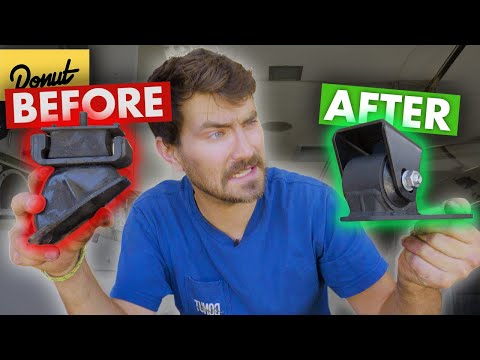
Engine mounts are the components that secure your engine to the vehicle's chassis (the frame of the car). They are not just simple bolts; they are designed to act as shock absorbers. Most mounts consist of a metal housing with a heavy-duty rubber insulator in the middle. This rubber absorbs the vibrations produced by the engine so they do not transfer into the cabin, ensuring a smooth ride.
In many modern vehicles, these mounts are more complex than simple rubber blocks:
- Hydraulic Mounts: These are hollow and filled with a glycol-based fluid to better dampen vibrations. They can leak when they fail.
- Electronic (Active) Mounts: Found in luxury or high-performance vehicles, these use sensors to change their stiffness based on engine RPM.
- Transmission Mounts: Most cars have between three and five mounts in total, including transmission mounts, which serve a similar purpose for the gearbox.

Average Engine Mount Cost
When looking at your repair estimate, the total will be split between parts and labor. It is important to remember that engine mount replacement cost varies significantly by geographic location, labor rates in your area, taxes, shop fees, and the specific condition of your vehicle.
Parts Cost
The price for the parts themselves can vary wildly based on technology:
- Standard Rubber Mounts: $50 to $150 per part.
- Hydraulic Mounts: $150 to $350 per part.
- Electronic and Active Mounts: $500 or more per part.
While aftermarket parts are often cheaper than Original Equipment Manufacturer (OEM) parts, many experienced technicians recommend OEM mounts. Lower-quality rubber in cheap aftermarket mounts can sometimes be too stiff or too soft, resulting in more vibration than the worn-out mount you are replacing.
Labor Cost
The engine mount labor cost is usually the largest portion of the bill. Most mount replacements take between 1.5 and 4 hours of labor. At a national average labor rate of $120 to $180 per hour, you are looking at $180 to $720 in labor per mount.
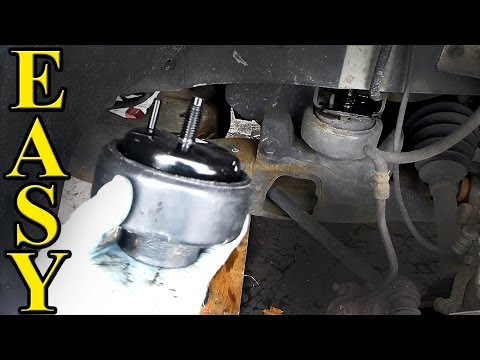
Some mounts are "easy," located right at the top of the engine bay. Others are "buried" under the engine or subframe, requiring the technician to support the engine with a hoist, remove the subframe, or move air conditioning lines and exhaust components just to reach the mounting bolts.
What Can Make the Repair More Expensive?
Several factors can drive the engine mount price toward the higher end of the spectrum:
- Engine Configuration: In many front-wheel-drive vehicles with V6 engines, the "rear" mount (located near the firewall) is notoriously difficult to reach. This "buried" location can double or triple the labor time compared to a front mount.
- All-Wheel Drive (AWD): AWD systems add extra components like transfer cases and drive shafts that may need to be disconnected or moved to access the mounts.
- Collateral Damage: If a mount has been broken for a long time, the excessive engine movement may have damaged other parts, such as radiator hoses, exhaust manifold gaskets, or wiring harnesses. These will need to be repaired at the same time.
- Number of Mounts: Often, when one mount fails, the others are close behind because they have been carrying the extra load. Replacing three mounts at once will be cheaper in total labor than replacing them one by one over three separate visits, but the immediate bill will be much higher.
Dealership vs. Independent Repair Shop
Where you take your vehicle will change the how much does an engine mount replacement cost calculation.
- Dealerships: Generally have the highest labor rates and will almost exclusively use OEM parts. You might pay $1,200 at a dealer for a job that an independent shop would do for $800. However, dealers have specialized tools and specific experience with your model's common failure points.
- Independent Repair Shops: Usually offer lower labor rates and more flexibility in parts selection. If you are looking for a balance between quality and cost, a reputable independent shop is often the best choice.
- Specialty Shops: These shops focus on specific makes (like European imports). They may charge rates similar to a dealership but offer high expertise for complex hydraulic or electronic systems found in brands like BMW, Mercedes-Benz, or Audi.
A Note on DIY: While replacing a mount yourself can save hundreds in labor, it is not recommended for beginners. It requires safely supporting the weight of the engine with a jack or hoist while the mount is removed. If the engine shifts or falls, it can cause catastrophic damage or personal injury.
Can You Drive With This Problem?
Can I drive with bad engine mounts? The short answer is yes, for a short period, but it is not a good idea. A failed mount allows the engine to "rock" or "jump" inside the engine bay. This puts immense stress on every hose, wire, and mechanical link connected to the engine.
Common symptoms that lead to this repair include:
- Excessive vibration felt through the steering wheel or seat.
- A loud "clunk" or "thump" during acceleration or when shifting gears.
- Engine movement thumping during heavy acceleration.
- Harsh shifting sensations.
- Visual engine movement when the hood is open and the engine is revved.
If you hear a loud metallic clunking, the mount is likely completely separated. In this condition, you should stop driving the vehicle immediately. A shifting engine can cause the throttle to stick, pull wires out of their connectors, or even cause the cooling fan to hit the radiator.
How to Avoid Paying for Unnecessary Repairs
The most important step in avoiding unnecessary costs is a proper diagnosis. Do not assume that a vibration automatically means you need every mount replaced. Unlike some engine issues, an OBD-II scanner code will not usually tell you a mount is bad.
A technician should perform a visual inspection for cracked rubber or leaking fluid, and a "torque test." During a torque test, one person holds the brake and lightly presses the gas while another observes how much the engine moves.
Diagnostic fees are standard. Expect to pay for 0.5 to 1 hour of diagnostic time (roughly $60 to $150) to confirm the failure. This ensures you are not replacing mounts when the real issue is an engine misfire or a transmission problem.
Questions to Ask the Repair Shop
Before you approve the work, ask these questions to ensure the engine mount replacement cost is fair:
- Is the estimate for one mount or the entire set?
- Are you using OEM mounts or aftermarket parts?
- Is there a specific reason you are recommending the replacement of the non-broken mounts? (e.g., Is the labor overlapping?)
- Does this price include the diagnostic fee, or is that extra?
- Are there any other components, like transmission mounts or exhaust hangers, that are also failing?
Bottom Line
Is engine mount replacement worth it? Absolutely. Engine mount replacement is a vital service that maintains the comfort, performance, and safety of your vehicle. While a $300 to $1,500 price tag can be a surprise, ignoring the problem will almost certainly lead to more expensive repairs—like snapped coolant lines or damaged exhaust systems—down the road. By understanding whether your vehicle uses simple rubber or complex hydraulic mounts, you can better anticipate the final cost and make an informed decision at the repair shop.



No Comments Yet
Be the first to comment on this article.