Curtis.Castiglione@ROzebra.com

CV Joint Replacement Cost Guide
By Curtis Castiglione
If you have noticed a rhythmic clicking sound while making a sharp turn, you are likely facing a CV joint repair. For most vehicle owners, a CV joint replacement cost typically ranges from $300 to $900 per axle. However, this price can climb significantly higher for luxury vehicles, heavy-duty trucks, or cars with complex all-wheel-drive systems.
The wide range in cost is due to a fundamental choice your mechanic has to make: whether to replace the individual CV joint and its rubber boot or to replace the entire CV axle assembly. In the modern repair industry, replacing the complete axle is the standard practice because it is often more cost-effective and reliable for the consumer.
It is important to remember that repair prices vary by geographic location, vehicle year, make, model, engine type, and the local labor rate. Shop fees, taxes, and the specific brand of parts selected will also influence your final invoice.
What Is CV Joint Replacement?
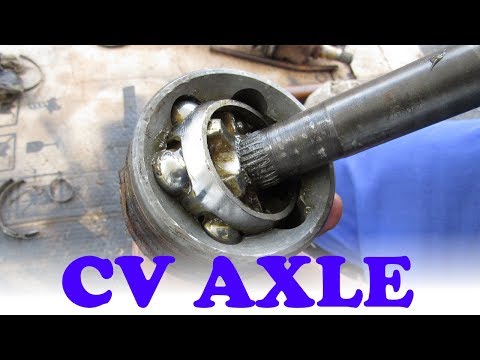
CV stands for Constant Velocity. CV joints are flexible couplings located at the ends of your vehicle's drive axles, often referred to as half-shafts. Their job is to transfer power from the transmission to the wheels at a constant speed, even as the wheels move up and down over bumps and turn left or right for steering.
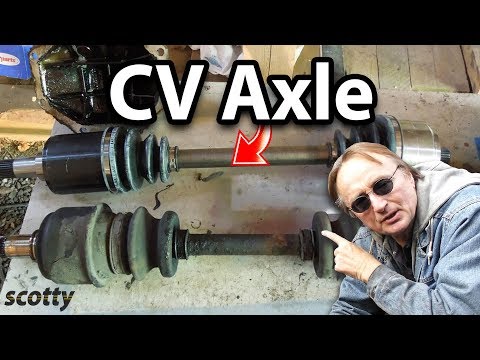
Most front-wheel-drive cars have two axles, with each shaft having an inner joint (near the transmission) and an outer joint (near the wheel). These joints are packed with specialized high-pressure grease and protected by a flexible rubber or plastic cover called a CV boot.
A CV joint replacement involves removing the drive axle from the vehicle. If only the joint is being serviced, the mechanic disassembles the axle, cleans the components, installs a new joint and boot, and repacks it with grease. However, if the joint has been clicking for a while, the internal metal is already damaged. In these cases, installing a complete new axle assembly is the preferred method of repair.
Average CV Joint Replacement Cost
When estimating how much does a CV joint replacement cost, you must look at the two halves of the bill: parts and labor. On average, a standard passenger sedan might cost between $350 and $600 for a single axle replacement at an independent shop.
Parts Cost
The CV joint price for parts usually ranges from $100 to $300 for a standard CV axle assembly. If you are only purchasing a CV boot kit, the parts cost might be as low as $30 to $60. However, the labor required to rebuild a joint is much higher than simply swapping an axle, often making the boot-only repair a poor financial choice if the axle is already out of the car. For luxury brands like BMW, Mercedes-Benz, or Audi, a high-quality OEM (Original Equipment Manufacturer) axle can easily cost $600 to $1,000 for the part alone.
Labor Cost
The CV joint labor cost generally accounts for 1.5 to 3 hours of work. At a national average labor rate of $100 to $180 per hour, you can expect to pay between $150 and $540 in labor. Some vehicles require the removal of several suspension components, such as control arms or ball joints, to gain access to the axle, which pushes the labor time toward the higher end of the scale.
What Can Make the Repair More Expensive?
Several factors can drive the total CV joint replacement cost upward:
- Vehicle Type: Four-wheel-drive and all-wheel-drive vehicles have more CV joints and axles than two-wheel-drive cars. If multiple boots have failed due to age, the cost can quickly double or quadruple.
- Rust and Corrosion: In regions where road salt is used, axles can become seized into the wheel hub. Mechanics may need extra time or specialized hydraulic tools to press the old axle out, which adds to the labor total.
- Related Damage: If a CV joint fails violently, it can damage the wheel bearing, the transmission seal, or the ABS (anti-lock braking system) sensor.
- Hub Nut Replacement: Many manufacturers specify that the large nut holding the axle to the hub is a one-time-use component. While inexpensive, it is an additional part that must be included for a safe repair.

Dealership vs. Independent Repair Shop
A dealership will almost always be the most expensive option. They use original factory parts and typically have higher labor rates. You might pay $800 to $1,200 for a repair that an independent shop would perform for $500. However, dealerships offer specialized brand knowledge and a national warranty that is honored at any of their locations.
Independent repair shops are usually more budget-friendly. They often use high-quality aftermarket parts which carry their own warranties and perform just as well as factory parts for a fraction of the price.
Specialty shops, such as those focusing on transmissions or drivelines, may offer the best balance of expertise and price. DIY repair is possible for those with the right tools, potentially saving hundreds in labor, but it requires a high-torque impact wrench, a large torque wrench for reinstallation, and the ability to safely support the vehicle on jack stands.
Can I Drive With This Problem?
If you are asking, can I drive with a clicking CV joint, the answer is: yes, but not for long.
A clicking sound means the joint is already worn and the grease has likely leaked out or become contaminated with dirt. Once the joint loses lubrication, heat builds up and the metal components begin to grind away. If the joint fails completely while you are driving, the axle will snap. This results in an immediate loss of power to the wheels. In some cases, the spinning broken axle can flail around and cause massive damage to your brake lines, suspension, or transmission. If the clicking is loud or you feel a vibration, the vehicle should be repaired immediately.
How to Avoid Paying for Unnecessary Repairs
One of the best ways to save money is to catch a torn CV boot early. During every oil change, ask your mechanic to perform a visual inspection of the rubber boots. If a boot is torn but the joint is not yet making noise, you might be able to simply replace the boot and grease.
However, be wary if a shop insists on replacing both the left and right axles when only one is clicking. While the other side may be the same age, it does not necessarily mean it has failed. Only replace the side that is damaged unless the other boot is visibly cracked or leaking.
Is CV joint replacement worth it? Absolutely. Compared to the cost of a tow truck and the potential damage caused by an axle snapping at highway speeds, a proactive replacement is a bargain.
Questions to Ask the Repair Shop
Before you authorize the work, ask the service writer or mechanic the following questions:
- Does the estimate include a brand-new axle or a remanufactured one? (New is generally preferred for long-term reliability).
- Does the price include a front-end alignment? (Some vehicles require an alignment after the suspension is disturbed during axle removal).
- Is there a warranty on both the parts and the labor?
- Are the transmission seals being inspected or replaced during the process? (It is often cheaper to replace a $20 seal while the axle is already out).
- Did you find any damage to the wheel bearing or the CV boot on the opposite side?
Bottom Line
While the typical CV joint replacement cost is between $300 and $900, the best way to keep this price on the lower end is to pay attention to your vehicle's warning signs. Address torn boots before they turn into clicking joints, and address clicking joints before they turn into a broken axle. Always request a written estimate that breaks down the parts and labor separately, and remember that an honest shop will be happy to show you the torn boot or the play in the joint before they begin the work.



No Comments Yet
Be the first to comment on this article.