Curtis.Castiglione@ROzebra.com

Control Arm Bushing Deformation and Symptoms
Have you ever noticed your car feeling a bit nervous when you are driving over a patch of rough pavement? Perhaps you have heard a mysterious, heavy thud whenever you step on the brakes or accelerate from a stop. It feels like something is shifting underneath the floorboards—almost as if the wheels are deciding which direction to go a split second before the steering wheel does.
You might also notice that your car seems to dart to one side when you hit the gas and then pull the other way when you slow down. These sensations are what we technicians call a "wandering" steering feel, and they are classic signs that your suspension is losing its composure.
What is a Control Arm Bushing?
To understand why your car is acting this way, you have to think of these bushings as the cartilage in your vehicle's joints.
The control arms are heavy metal components that connect your wheel assembly to the vehicle's frame. Their job is to allow the wheels to move up and down over bumps while keeping them precisely pointed in the right direction. However, if those metal arms were bolted directly to the metal frame, every pebble on the road would vibrate your teeth, and the noise would be unbearable.
To prevent this, engineers press elastic bushings—usually made of high-density rubber or polyurethane—into the ends of the control arms. These bushings serve two critical purposes:
- Isolation: They soak up road noise and vibration.
- Pivot Point: They allow the suspension to travel vertically without any "play" or side-to-side movement.
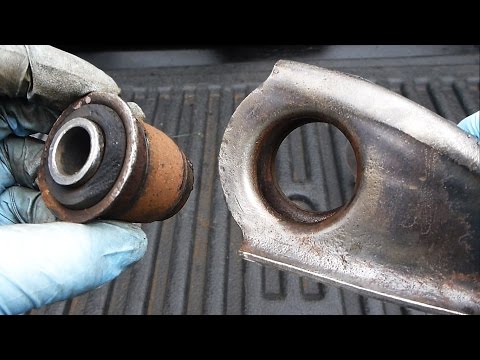
The Three Enemies of Your Suspension
When these bushings are healthy, they are firm yet pliable. But over time, they face three primary enemies that lead to deformation:
- Age and Dry Rot: As rubber ages, it loses its essential oils and elasticity. It begins to develop "spiderweb" cracking, which eventually leads to full separation where the rubber actually tears away from the metal sleeve.
- Oil Contamination: This is a silent killer. If your engine or power steering system has even a small leak, that fluid can drip onto the rubber bushings. Petroleum products cause rubber to soften, swell, and eventually turn into a mushy, sponge-like consistency.
- Mechanical Stress: Constant pounding from deep potholes or the heavy torque generated by frequent hard braking can physically tear the rubber apart.
The Technical Result: Bushing Walk
When the rubber fails, we see a phenomenon called bushing walk. This occurs when the control arm is no longer centered within the bushing.
Under the load of acceleration or braking, the arm actually "walks" or shifts out of its intended position. This ruins your vehicle's alignment geometry. Specifically, it compromises the roll center of the car—the theoretical point around which the body corners. If the bushings are deformed, the roll center shifts unpredictably, making the car feel unstable, tipsy, or "darty" during turns. That clunk you hear? That is the sound of the metal control arm hitting the limits of its housing because the rubber is no longer there to cushion the blow.
How to Inspect Your Bushings
If you suspect your bushings are failing, you can perform a basic visual inspection at home:
- The Visual Check: Turn your wheels all the way to one side and look behind the tire where the control arm meets the frame. Look for cracking, chunks of missing rubber, or black soot-like dust (which is actually pulverized rubber).
- The Off-Center Test: If you see the inner metal sleeve of the bushing sitting off-center within the outer shell, the bushing has failed.
- The Pry Bar Diagnostic: While the vehicle is safely supported on jack stands, a technician will use a pry bar between the control arm and the frame. A healthy bushing should feel like a very stiff spring with almost no lateral movement. If the arm moves easily or the rubber pulls away from the metal, it is time for a replacement.

Don't Ignore the Wander
Ignoring deformed bushings does more than just ruin your ride quality. Because the wheels are no longer held at the correct angle, you will experience rapid, uneven tire wear, potentially scrubbing the tread off a new set of tires in just a few thousand miles. Furthermore, the excess movement puts undue stress on your ball joints and steering rack.
What to tell your mechanic: When you drop your car off, be specific. Tell them: "I am noticing a wandering sensation in the steering and a clunking sound during weight transfers like braking and accelerating. I am concerned about bushing walk or dry rot in the control arms."
Catching this early ensures that a simple rubber part replacement does not turn into a much more expensive repair involving a full set of tires and a complete front-end rebuild. Safety and precision are worth the investment!
Written by Curtis Castiglione



No Comments Yet
Be the first to comment on this article.