Curtis.Castiglione@ROzebra.com

2021 Ford F-250 Front-End Collision Repair and Insurance Guide
To the untrained eye, a front-end collision on a 2021 Ford F-250 Super Duty might look like nothing more than a mangled chrome bumper and a cracked plastic grille. However, beneath that heavy-duty exterior lies a complex network of cooling components, structural supports, and precision electronics. If you are a truck owner looking at an initial insurance estimate that seems low—or a final bill that seems surprisingly high—it is important to understand that in the world of modern collision repair, what you see is rarely what you get.
The 2021 F-250 is a sophisticated machine. When the front end is impacted, the energy does not stop at the chrome. It travels through the bumper reinforcement into the radiator support, the cooling package, and the hood-latching mechanism. Understanding how these components interact is vital for ensuring your truck is safe to drive and that your insurance claim covers the actual cost of restoration.
The Skeleton of the Front End: The Radiator Support
The radiator support is the structural framework that ties the front of your truck together. On a 2021 F-250, this component is responsible for holding the headlights, the entire cooling stack, and most importantly, the hood latch.
In a front-end hit, the bumper reinforcement (the heavy bar behind the plastic or chrome cover) often transfers energy directly into this support. Even a slight shift—as little as a few millimeters—can throw the entire front end out of alignment.

A common mistake in collision estimating is assuming that if the hood closes, the latch is fine. This is a dangerous assumption. If the support is shifted or twisted, the secondary safety catch may not engage properly. At highway speeds, wind pressure can catch an improperly latched hood, causing it to fly open and obscure the windshield. This is why a professional shop must perform a specific hood-latch inspection, checking the relationship between the striker and the latch support independently of the outer sheet metal.
The Complexity of the Cooling Stack
Modern heavy-duty trucks, especially those equipped with the 6.7L Power Stroke diesel or the 7.3L V8, have incredibly dense cooling stacks. You are not just looking at one radiator. You are looking at a combination of:
- The primary engine radiator
- The A/C condenser
- The transmission oil cooler
- The turbocharger intercooler (on diesel models)
- The power steering cooler
In a front-end hit, these components can be compressed against one another. Even if you do not see coolant leaking on the ground, the mounting tabs may be snapped, or the cooling fins may be rolled over, restricting airflow.
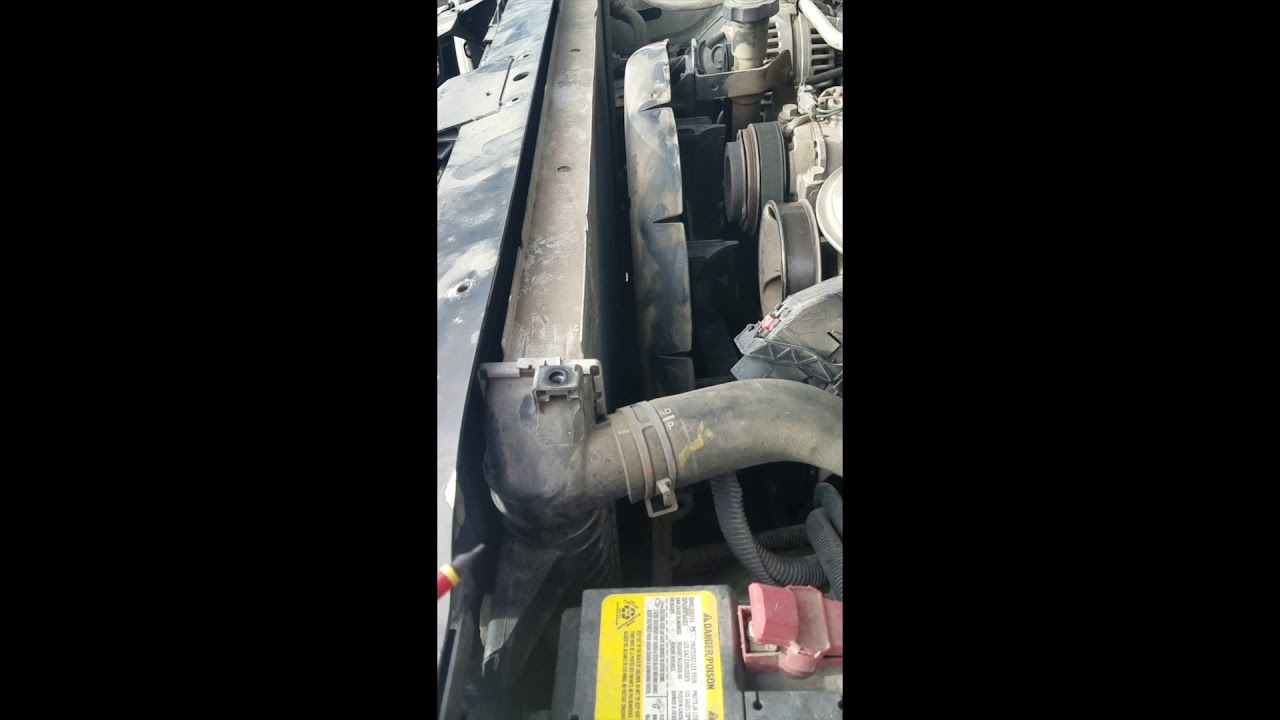
Furthermore, the cooling fan assembly sits just inches behind these components. If the radiator support is pushed back, the fan can strike the shroud or the radiator itself, leading to catastrophic engine overheating miles down the road.
Why Did My Estimate Change?
When you first file a claim, the insurance company may write an initial estimate based on photos or a quick walk-around. This is rarely the final cost of the repair. In the industry, the difference between the initial estimate and the final bill is called a supplement.
The true scope of damage on a 2021 F-250 cannot be determined until the teardown phase. Once the bumper and grille are removed, the shop can inspect the front wiring harnesses, the bumper reinforcements, and the various sensors used for Advanced Driver Assistance Systems (ADAS).
Many F-250s are equipped with front-facing cameras or radar sensors for adaptive cruise control. If these brackets are bent, the system will require professional calibration to function correctly. Calibration is mandatory; if a sensor is removed or its bracket is even slightly adjusted, the system must be recalibrated using specialized software to ensure the safety features work as intended.
OEM versus Aftermarket Parts
Insurance policies generally state that the insurer will pay to return the vehicle to its pre-accident condition. However, disagreements often arise regarding the parts used. Insurance companies may push for Aftermarket or Recycled (used) parts to save costs.
For a 2021 F-250, using Original Equipment Manufacturer (OEM) parts is often critical for the radiator support and hood latch. Aftermarket structural parts may not have the same tolerances, which can lead to persistent issues with hood alignment or cooling system vibration. You should review your policy to see if you have an OEM Parts Choice endorsement. If not, the shop may need to document why an aftermarket part is insufficient—for example, if it interferes with the calibration of safety sensors or fails to meet the precise fit required for the cooling stack.
What Should I Do After a Front-End Collision?
If your F-250 has been in an accident, do not assume the initial insurance check is the final word. To protect the value and safety of your truck, take the following steps:
- Request a Teardown: Ask the repair facility to perform a complete disassembly of the front end to look for hidden damage to the cooling stack and wiring.
- Verify Latch Alignment: Ask the shop specifically if they checked the hood latch engagement and whether the radiator support was measured for squareness.
- Check for ADAS Calibration: If your truck has a front camera or radar, ensure the estimate includes the labor and specialized software costs required to recalibrate these systems.
- Inspect the Cooling Package: Ask the technician if the cooling fan and all heat exchangers were pressure-tested or inspected for stress cracks at the mounting points.
- Document Everything: If the insurance company refuses to pay for a necessary diagnostic scan or a specific repair procedure recommended by Ford, ask for that refusal in writing.
A truck like the F-250 is built for work, but its front-end components are precisely engineered. Treating a front-end collision as a simple cosmetic fix can lead to safety risks and long-term mechanical headaches. By focusing on the structural and mechanical integrity of the cooling and latching systems, you can ensure your truck is truly restored to its pre-loss condition.



No Comments Yet
Be the first to comment on this article.