Curtis.Castiglione@ROzebra.com

2020 Ram 1500 Front Suspension Collision Repair and Insurance
If you have been involved in a front-wheel collision in a 2020 Ram 1500, the damage you see on the surface rarely tells the whole story. A common question vehicle owners ask is: 'Why did my repair estimate double after the shop started working on it?'
The answer lies in how impact forces travel through a truck’s suspension system and the rigorous diagnostic steps required to ensure the vehicle is safe to drive. On a heavy-duty frame like the Ram 1500, what looks like a simple wheel and tire job often hides significant mechanical compromises.
The Path of Least Resistance: How Impact Forces Travel
When a front wheel takes a direct hit—whether from another vehicle or a stationary object like a curb—that energy does not simply stop at the wheel. It follows a path through the mechanical components. On a 2020 Ram 1500, this path typically follows a specific sequence:
- The Wheel and Tire: These absorb the initial shock and often show the most obvious signs of damage.
- The Hub and Bearing: This is the central pivot point. Impact energy can flat-spot the internal bearings.
- The Steering Knuckle: The heavy component that connects the wheel to the suspension and steering system.
- Control Arms (Upper and Lower) and Tie Rods: These are the 'limbs' that hold the knuckle in place. They are designed to manage vertical travel, not horizontal impact.
- The Strut and Shock Assembly: These manage movement but can be bent by lateral forces, ruining the internal seals or the piston rod.
The 'Visual Estimate' vs. The Insurance Supplement
The initial estimate written by an insurance adjuster in your driveway or via a photo-based app is known as a visual estimate. Adjusters can see a scuffed wheel or a blown tire, but they cannot see a hairline crack in a steering knuckle or a control arm that is bent by only three millimeters while the truck is sitting on its own weight.
This is why the insurance supplement process is a standard part of collision repair. Once the truck is placed on a lift and the wheel is removed, a technician performs a teardown. This involves disassembling the suspected components to identify hidden damage. When the shop finds these issues, they submit a 'supplement' to the insurance company—an additional request for funds to cover the newly discovered, necessary repairs.
Critical Components Often Overlooked
1. The Steering Knuckle
On many modern trucks, steering knuckles are made of cast aluminum or high-strength steel. While they are designed to be rigid, a hard impact can bend them or cause 'ear' deformation where the tie rod or control arm connects. If the knuckle is bent even a fraction of a degree, the truck will never track straight, and your tires will wear out prematurely.
2. The Hub and Bearing Assembly
Even if the wheel still spins, the internal bearings may have been damaged by the force of the accident. This occurs when the metal balls inside the bearing are slammed into the race. You might not notice it immediately, but within a few hundred miles, it will manifest as a rhythmic humming noise or a vibration.

3. Alignment Geometry as a Diagnostic Tool
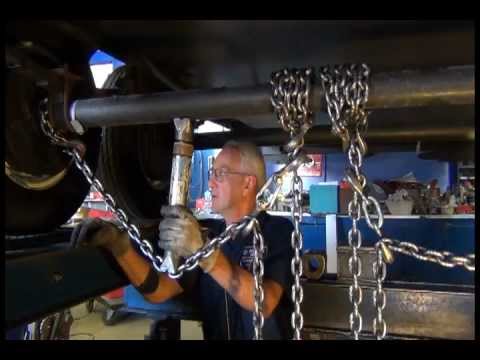
A wheel alignment is not just a final touch; it is one of the most important diagnostic tools in a suspension claim. A pre-alignment check allows the technician to see the 'health' of the suspension. If the technician cannot bring the truck into factory specifications using the standard adjustment points, it is a mathematical certainty that a component—like a knuckle or control arm—is bent. These alignment readings provide the documented proof needed to justify additional repairs to an insurance company.
Modern Technology: ADAS and Electronics
The 2020 Ram 1500 is more than just metal and rubber; it is a rolling computer. A hit to the front corner often involves:
- ABS Wheel Speed Sensors: These are easily snagged or crushed during an impact, leading to dashboard warning lights.
- Advanced Driver Assistance Systems (ADAS): Many of these trucks feature lane-keep assist and electronic stability control.
- Steering Angle Sensor (SAS) Calibration: If the steering geometry is altered or if the steering rack is replaced, the SAS must be recalibrated. If this is not done, the truck's safety systems may intervene at the wrong time because they 'think' the wheels are pointed in a different direction than they actually are.
Parts Selection: OEM vs. Aftermarket and Recycled
During the repair process, you may encounter a disagreement between your insurance policy and manufacturer recommendations regarding parts.
- Insurance View: Your carrier may suggest using recycled (used) suspension components or aftermarket parts to manage costs.
- Manufacturer View: Many OEMs (Original Equipment Manufacturers) recommend against using recycled suspension parts because their history is unknown. A recycled knuckle could have come from a truck that was in a similar accident, harboring internal stresses that are not visible.
Review your policy and discuss with your repair facility whether they are following the specific manufacturer repair procedures for your Ram.
Frequently Asked Questions
Does insurance cover hidden suspension damage? Yes, provided the damage is a direct result of the covered loss (the accident). This is handled through the supplement process.
Why did my repair cost more than the original check I received? Because the original check was likely based on a visual-only inspection. Once the vehicle was disassembled and measured, the full extent of the mechanical damage was realized.
Can I choose new OEM parts? This depends on your specific insurance policy language. Some policies allow for OEM parts on newer vehicles, while others stipulate the use of 'Like Kind and Quality' (LKQ/Recycled) parts.
Final Verification: What to Ask Your Shop
Before you pick up your truck, ensure the collision force was traced all the way through the system. Ask your service adviser these four questions:
- Was the hub bearing inspected for internal damage or play?
- Did the alignment readings confirm that the steering knuckle and control arms are straight?
- Were the brake rotor and caliper mounting brackets checked for runout or cracks?
- Were the ADAS systems and steering angle sensors recalibrated after the mechanical repairs?
Suspension damage is not a matter of cosmetics; it is a matter of mechanical integrity. Ensuring your truck is returned to pre-accident condition requires a thorough teardown, precise measurement, and a final road test to check for vibrations or pulling.
Note: Insurance policies and state laws vary. Always review your policy and consult with your insurance company or a qualified collision professional regarding your specific claim.
Written by Curtis Castiglione



No Comments Yet
Be the first to comment on this article.